
The Cuticle myth
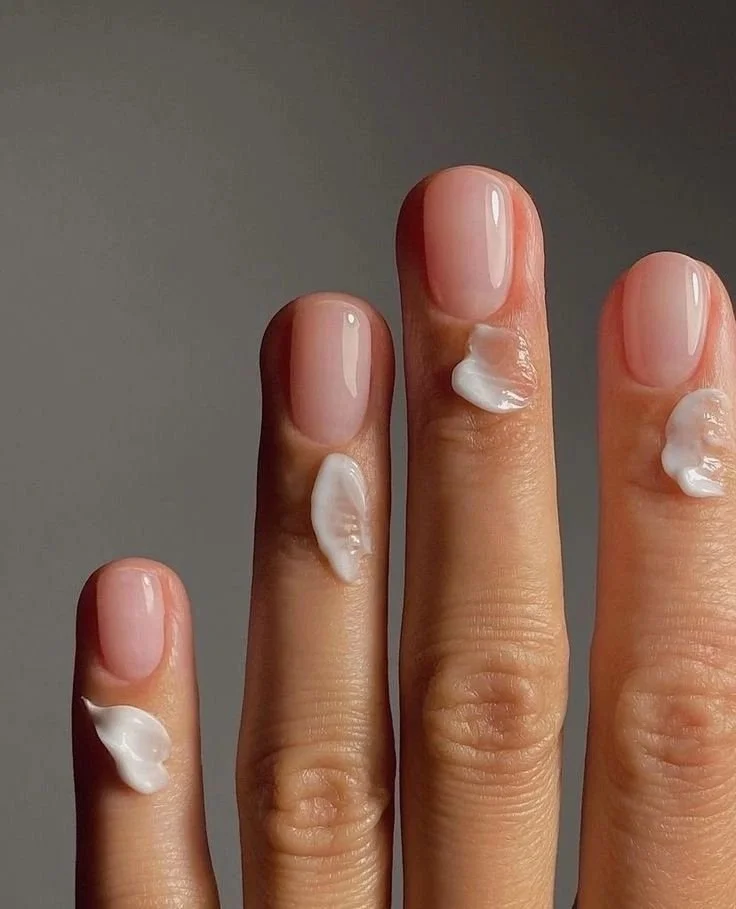
On over-cutting, “perfect” manicures, and the business of maintenance.
For years, one of the beauty industry’s most convincing visual tricks has been equating “clean” with “removed.”
Removed cuticles.
Removed texture.
Removed evidence that skin is, in fact, living tissue.
Somewhere along the line, women began associating aggressively cut cuticles with luxury, largely because the result photographs beautifully for approximately forty-eight hours.
Sharp. Glossy. Extremely precise.
But biologically speaking, healthy cuticles were never meant to disappear entirely.
They exist to protect the nail matrix from bacteria, irritation, moisture imbalance, and environmental stress. The cuticle acts as a protective seal between the skin and the growing nail: functional tissue, not excess material waiting to be eliminated for aesthetic purposes.
Which is partly why overly aggressive cuticle cutting can become strangely self-perpetuating.
When living skin is repeatedly cut or aggressively disturbed, the body often responds by producing more of it, creating the illusion that constant removal is necessary to maintain the appearance. Many women unknowingly become trapped in a cycle where the maintenance itself creates the demand for more maintenance.
And increasingly, women are beginning to realize that immaculate-looking cuticles and healthy cuticles are not always the same thing.
When the protective barrier surrounding the nail becomes repeatedly compromised, some women experience persistent irritation, inflammation, tenderness, peeling, sensitivity, or recurring infections around the nail fold, particularly when paired with frequent moisture exposure and repeated salon services.
The same can be said for excessive e-file work.
Repeated thinning of the nail plate may temporarily create an ultra-smooth finish, but over time can compromise the integrity of the natural nail underneath. Ironically, some of the techniques marketed as “healthy” or “advanced” rely on progressively weakening the nail so the service itself becomes harder to stop.
And yet, the cultural mood around beauty has shifted dramatically.
The women increasingly setting aesthetic standards no longer look aggressively maintained. The modern codes of luxury are healthier skin, softer hair, understated clothing, immaculate grooming, and increasingly, nails that still look like real nails.
Restraint has returned.
Not neglect.
Not indifference.
Not “giving up.”
Restraint.
At Club House, we’ve always believed nail care should function more like skincare: supportive rather than corrective, preventative rather than aggressive, thoughtful rather than performative.
Which means preserving the health of the nail and surrounding skin whenever possible, not treating them as collateral damage in pursuit of a temporary finish.
Because ultimately, the most luxurious manicure in the room is rarely the one announcing itself the loudest.
Usually, it’s the healthiest-looking.
xx, Ashley
Editor, Club Confidential || Co-Founder, Club House
Ashley Palumbo is the co-founder of Club House, a hospitality-driven nail studio redefining modern manicure culture through a skincare-informed approach to nail health. She holds a degree in chemistry and spent nearly two decades in healthcare consulting and customer experience strategy before launching Club House and Club Confidential, an editorial publication exploring modern beauty, nail health, hospitality, lifestyle, and cultural trends.
